How to Choose the Right Drop Cable for Your Business Needs?
Choosing the right Drop Cable is essential for any business network. The type of drop cable you select influences data speed, reliability, and overall network performance. With numerous options available, this decision can feel overwhelming.
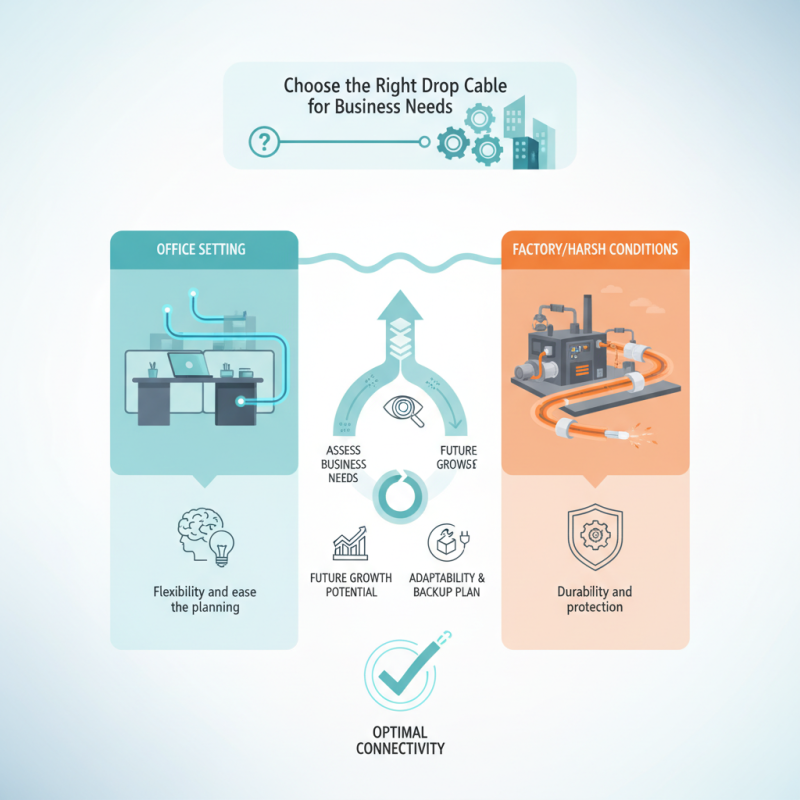
Understanding your business needs is crucial. Different environments require different cable specifications. For instance, an office setting might prioritize flexibility and ease of planning. In contrast, a factory might need durability against harsh conditions. An appropriate drop cable enhances connectivity and avoids frequent disruptions.
Ensure to assess everything before making a decision. Look at the potential for future growth. Have a backup plan if you need to switch cables later. The right drop cable will not only meet your current needs but also adapt as your business evolves. The journey to finding the perfect fit may take time, but it is worth the effort.
Understanding Drop Cables: Types and Applications for Business Needs
Drop cables are critical for businesses that require reliable network connections. Understanding the various types available can help you make informed decisions. Fiber optic drop cables provide high-speed data transmission, making them ideal for operations with high bandwidth. However, they can be more fragile than copper counterparts. On the other hand, copper drop cables are durable and easier to install. They might lack speed but are often sufficient for smaller operations.
When selecting a drop cable, consider your environment. Indoor scenarios may allow for less robust cables, while outdoor applications require more outdoor-rated options. The installation process should also be factored into your decision. If your team has limited expertise, a user-friendly option might be beneficial. Sometimes, enterprises overlook their specific needs. This can lead to issues down the line, like network bottlenecks. It's crucial to evaluate not just the present usage but also future scalability.
Additionally, keep in mind the total cost of ownership. While a less expensive option may seem appealing, long-term reliability is vital. Frequent replacements can be costly. You may also want to consult with experts or conduct further research. Practical experiences from other businesses can offer insight into which type performs best under similar conditions.
Comparison of Drop Cable Types for Business Needs
Evaluating the Performance Characteristics of Drop Cables
When selecting a drop cable for your business, evaluating performance characteristics is crucial. Drop cables play a significant role in network reliability and performance. According to industry reports, data transmission rates can be drastically affected by the type of drop cable used. For instance, a well-designed drop cable can improve data rates up to 1 Gbps, while inferior options might hinder speeds significantly.
Conducting a thorough assessment of cable specifications is essential. Factors such as attenuation, bandwidth, and environmental resilience should be considered. A recent study by the Fiber Broadband Association highlights that 70% of network issues can stem from cable quality and type. Using a cable that meets or exceeds industry standards can mitigate such risks. Overlooking these details may result in costly downtime or decreased productivity.
Consider the installation environment as well. Not all cables perform well in all conditions. For example, UV-resistant cables are vital for outdoor use, while flame-rated cables are essential in high-risk areas. Each installation has unique needs. Ignoring specific performance metrics may lead to a mismatch between your business demands and the capabilities of the drop cable. Thus, a careful evaluation can save time and resources in the long run.
How to Choose the Right Drop Cable for Your Business Needs?
| Drop Cable Type | Bandwidth (Mbps) | Distance (m) | Installation Environment | Flexibility Rating | Cost ($ per meter) |
| Fiber Optic Cable | 1000 | 1000 | Indoor/Outdoor | High | 2.50 |
| Coaxial Cable | 500 | 300 | Indoor | Medium | 0.75 |
| Ethernet Cable (Cat6) | 100 | 100 | Indoor | High | 0.50 |
| Twisted Pair Cable | 100 | 100 | Indoor | Medium | 0.30 |
| Direct Burial Cable | 1000 | 500 | Outdoor | Low | 2.00 |
Key Factors to Consider When Selecting Drop Cables
When selecting drop cables for your business, several key factors come into play. The type of environment where the cables will be installed is crucial. Will they be indoors or outdoors? Outdoor cables need to withstand moisture and ultraviolet light. Indoor cables may focus more on flexibility and ease of installation. Knowing your environment helps dictate the right materials and insulation types.
Another critical factor is the bandwidth requirements. Different applications demand varying data speeds. High-definition video streaming requires greater bandwidth compared to simpler data transfers. Evaluate the needs of your business to determine the required specifications.
It's tempting to opt for higher specifications; however, it might lead to over-saturation, which isn't always beneficial.
Additionally, consider the cable length. Longer distances can lead to signal loss, which may be counterproductive. Sometimes, using multiple shorter cables or amplifying signals may be a better option. Connectivity might be less straightforward than anticipated. Analyzing these details thoroughly can help avoid common pitfalls in cable selection and ensure a reliable, efficient networking experience.
Identifying the Right Drop Cable for Specific Business Environments
When selecting a drop cable for specific business environments, understanding your unique needs is crucial. A study by the Fiber Optic Association indicated that businesses with high data demands often require fiber drop cables due to their superior bandwidth capabilities. For instance, a modern medical facility may need to transmit large imaging files quickly without lag. This situation necessitates cables that support higher speeds and reliability.
In contrast, an office environment with standard internet usage might operate efficiently with copper drop cables. According to BSRIA's market report, the market share of copper drop cables is still significant, holding about 30% in specific industries. However, it’s vital not to ignore the limitations. Copper cables can suffer from attenuation over longer distances, affecting performance. Businesses must evaluate their current and future data needs to make informed decisions.
The right cable choice also involves considering installation conditions. For outdoor settings, durability comes into play. Weather-resistant materials are essential in such cases. This is a critical insight, as cables exposed to harsh conditions should maintain functionality. Not addressing these aspects might lead to costly downtimes and repairs. Re-evaluating how your infrastructure adapts to changes is beneficial, as technological advancements continue to evolve rapidly.
Installation and Maintenance Tips for Optimal Drop Cable Performance
Choosing the right drop cable is crucial for any business. Proper installation ensures that performance remains optimal. According to industry reports, up to 70% of network issues arise from improper cable management. Efficient installation can prevent many of these problems.
It is important to consider environmental factors when installing drop cables. Temperature fluctuations and humidity can affect cable performance. Regular maintenance checks are essential. These checks should include inspecting for wear and tear. A study from the Telecommunications Industry Association (TIA) reveals that regular inspections can extend cable life by up to 40%.
Moreover, proper routing of cables is often overlooked. Avoid sharp bends and excessive pulling. Simple routine tasks can lead to significant improvements. Mismanagement can result in costly downtime and reduced productivity. A mismatch in cables can lead to poor performance, highlighting the need for careful selection. Planning and proper maintenance are not just beneficial; they are necessary for reliable network performance.